
A Christian Meme
Who was it that raised Jesus (Heb. Y’hoshua/Yeshua) bodily from the dead, was it Jesus himself or was it God? I have seen a meme that has been circulated on FaceBook that says,
His death proved Jesus was human, and his resurrection proved he was God.
This meme sounds very “biblical” to most Christians and many Messianic believers, but this is not supported by the Bible. How could the resurrection of Jesus (Heb. Y’hoshua/Yeshua) prove that “he was God” when the Bible tells us that it was not Jesus who raised himself from the dead – but the God of Israel.
The Basis of the Meme
This meme is based a statement said by Jesus in the book of Yochanan (John) 2. After cleansing the Temple right before the Passover removing “the chametz (leaven),” and when he is asked by the religious leaders, “What sign do you show us that you can do these things?” (John 2:18) In response Jesus says,
Destroy this temple, and in three days I will raise it up. (John 2:19)
This statement is also brought up by two of “the false witnesses”:
And said, This fellow said, “I am able to destroy the temple of God, and to build it in three days. (Matthew 26:61)
And there arose certain, and bare false witness against him, saying, “We have heard him say, ‘I will destroy this temple that is made with hands, and within three days I will build another made without hands.” (Mark 14:57-58)
Interestingly, this statement is not found in the Gospel of Luke at all. Interestingly, if not for the statement made in John 2, we would have thought that this was a completely false testimony that they were given about Jesus since both Matthew and Mark says that it came from “false witnesses.”
However, according to Eusebius, in his book, Eusebius’ Ecclesiastical History: Complete and Unabridged, New Updated Edition (Hendrickson, 1998), he states that Yochanan (John) read all three synonymous Gospels of Matthew, Mark, and Luke, and he verified their writings, but there were things that they left out of their accounts from “the first of his deeds and at the commencement of the gospel” (Book 3, Chapters 24, line 7). One such fact may have included the statement said by Jesus in Yochanan (John) 2:19. This was also partially why the Gospel of John differs from the others.
Jesus – “The Holy Servant God”?
In Acts 4 when the Jewish disciples are praying to God, they call Jesus “Thy holy servant Jesus” twice within this prayer. The English word “servant” is pais (G3816), and it means,
C. The servant of God, spoken of a minister or ambassador of God, called and beloved of God, spoken of a minister or ambassador of God, called and beloved of God, and sent by Him to perform any service. (2241)
This is the definition that Jesus uses of himself. He is God’s ambassador representing Him and His Kingdom. Jesus (Heb. Y’hoshua/Yeshua) reconfirmed this definition of himself several times in the Gospel of John. Jesus was someone who God worked in and through to touch His people, Israel. Jesus says repeatedly that “he was sent by God.” For example,
My food is to do the will of Him [God] who sent me, and to complete His work. (John 4:34)
For example, in the same book, the Gospel of John, Jesus says,
But the witness which I have is greater than that of John, for the works which the Father has given me to accomplish, the very works that I do, bear witness of me that the Father has sent me. (John 5:36)
So just as all the plagues against Egypt and the miracles through the Exodus were not done by Moses, but by God working in and through him, so all the miracles – healings, cleansing the lepers, raising the dead, silencing the storm, multiplying food – was not done by Jesus himself – but by God working in and through him.
Jesus – “The Prophet of God”?
But most Christians assume that if the words were spoken by Jesus, then the words came from him, but what does Jesus (Heb. Y’hoshua/Yeshua) say?
My teaching is not mine, but His [God’s] who sent me. If any man is willing to do His [God’s] will, he shall know of the teaching; whether it is of God, or whether I speak from myself. He who speaks from himself seeks his own glory; but he who is seeking the glory of the One who sent him, he is true, and there is no unrighteousness in him. (John 7:16-18)
According to Jesus (Heb. Y’hoshua/Yeshua) himself, if Jesus had spoken his own words, then he would have been seeking his own glory, but Jesus was saying here that the words he spoke were given to him by God. Again Jesus says,
I have many things to speak and to judge concerning you, but He [God] who sent me is True; and the things which I heard from him, these I speak to the world…and I do nothing on my own initiative, but I speak these things the Father [God] taught me to say. And He who sent me is with me; He has not left me alone, for I always do those things that are pleasing to Him. (John 8:26, 28b-29)
And again, Jesus says,
And if anyone hears my sayings, and does not keep them, I do not judge him; for I did not come to judge the world, but to save the world. He who rejects me, and does not receive my sayings, has one who judges him, the word I spoke is who will judge him; the word I spoke is what will judge him at the last day. (John 12:47-48)
And why will we all be judged by the words that he spoke:
For I did not speak on my own initiative, but the Father [God] Himself who sent me has given me commandment, what to say, and what to speak. And I know that His commandment is eternal life; therefore the things I speak, I speak just as the Father has told me. (John 12:49-50)
If the words of God are eternal life, does this include all the words of God, including the first five books of Moses and the rest of the Hebrew Scriptures? Jesus says again in John,
Do you not believe that I am in the Father, and the Father is in me? (John 14:10)
This means that Jesus shares a great intimacy with God, greater than any of us can really understand. He then continues,
The words that I say to you I do not speak on my own initiative, but the Father abiding in Me does His works. Believe me that I am in the Father, and the Father in me; otherwise believe on account of the works themselves. (John 14:19-20)
And again, Jesus says,
If anyone loves me, he will keep my word; and my Father [God] will love him, and we will come to him, and make our abode with him. (John 14:23)
But why will God love him for us keeping Jesus’ teachings, because his teachings and words came from God Himself, so it is not Jesus’ teachings we are keeping – but God’s. Then in the next verse, he says,
He who does not love me does not keep my words;and the word which you hear is not mine, but the Father’s who sent me. (John 14:24)
So repeatedly when Jesus speaks, he is speaking the words of God, not His own words or thoughts – but God’s. So when Jesus said, “Destroy this temple, and in three days I will raise it up,” these are not the words of Jesus, but the words of God. God was calling Jesus “His temple,” and it would be God Himsefl who would raise him up again from the dead.
Jesus – “the Temple of God”?
So in Yochanan (John) 2,
Jesus answered them, “Destroy this temple, and in three days I will raise it up again.” The Judeans [better – “some Jewish leaders”] said, “It took 46 years to build this Temple, and you’re going to raise it in three days?” But the “temple” he had spoken of was his body. [Yochanan (John) 19-21]
Was Jesus (Heb. Y’hoshua/Yeshua) saying this about himself, or was he saying the words which God gave him to say? Was Jesus calling himself “this temple,” or was it God who was calling Jesus His “temple”? Was the “I” in his statement referring to Jesus himself, or was it referring to God?
Who Raised Jesus from the Dead?
If we look at what the rest of the “New Testament” teaches, we will discover that Jesus was not speaking himself, but he was speaking the words which God told him to say, and that it was God who raised him up from the dead.
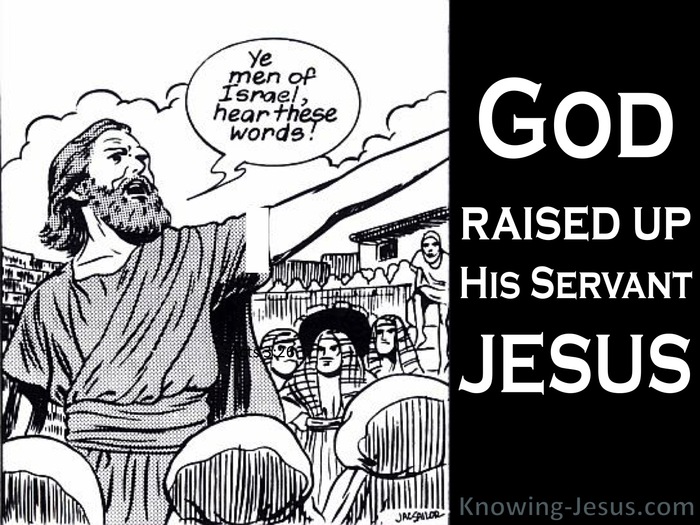
For example, in Acts 2, Shi’mon Petros (Peter) testifies:
But GOD HAS RAISED HIM UP and freed him from the suffering of death; it was impossible that death could keep its hold on him. (Acts 2:24, CJB; emphasis added)
GOD RAISED UP THIS JESUS (Heb. Y’hoshua/Yeshua)! And we are all witnesses of it! (Acts 2:32, CJB; emphasis added)
And then again in Acts 3,
But GOD HAS RAISED HIM FROM THE DEAD! Of this we are witnesses. (Acts 3:15, CJB; emphasis added)
Stephen
In Acts 4, Stephen says while on trial before the Sanhedrin,
then let it be known to you and to all the people of Israel that it is in the name of the Messiah, Jesus/Yeshua from Natzeret, whom you had executed on a stake as a criminal but whom GOD HAS RAISED FROM THE DEAD, that this man stands before you perfectly healed. (Acts 4:10, CJB; emphasis added)
KEFA (PETER) and the Other EMISSARIES (Apostles)
Then in Acts 5, Kefa (Peter) and the other emissaries (apostles) state before the Sanhedrin,
Kefa and the other emissaries answered, “We must obey God, not men, THE GOD OF OUR FATHERS RAISED UP JESUS/YESHUA, whereas you men killed him by having him hanged on a stake.” (Acts 5:29-30. CJB: emphasis added)
Rav Sha’ul Paulus (Paul)
Even in the teachings and writings of the second-generation Beyt Hillel Pharisee, Rav Sha’ul Paulus (Paul), Jesus/Yeshua did not raise himself from the dead, but God did. For example, For example, in Acts 13,
Brethren, sons of Abraham’s family, and those among you who fear God, to us the word of this salavation is sent out. (Acts 13:26)
In this verse, Rav Sha’ul Paulus (Paul) identifies the two groups to whom this “the word of this salvation” is sent. And then he later continues,
…they took him down from the cross and laid him in a tomb. But God raised him from the dead; and for many days he appeared to those who came up with him from Galilee to Jerusalem, the very ones who are now his witnesses to the people. And we preach to you the good news of the promise to the fathers (the patriarchs of Israel), that God has fulfilled this promise to our children in that He [God] raised up Jesus/Yeshua, as it is also written in the Second Psalm, “You are My son; today I have begotten you.” And as for the fact that He [God] raised him from the dead, no more to return to decay, He [God] has spoken to us in this way, “I will give you the holy and sure blessings of David.’ Therefore He [God] also says in another Psalm, “You will not allow your Holy One to undergo decay.” (Acts 13: 29b-35)
There is not one disciple that teaches that Jesus/Yeshua raised himself in all the “New Testament,” but we have a total of 25 different passages by the Jewish disciples and by Paul humsef that it was God who raised up Jesus/Yeshua – not Jesus/Yeshua himself. So even though this Christian meme – “His death proved Jesus/Yeshua was human, and his resurrection proved he was God” – seems “biblical” on the surface, but when we examine clearly what the Bible actually teaches, it really is in direct contradiction to the Bible. In truth, how could the resurrection prove “he was God,” when there are 25 different passages in the “New Testament” that state that it was “God who raised Jesus/Yeshua from the dead”?
 followingmessiah.org